
Cast Study
Rethinking how people search for holidays
We built a search experience that works for customers who know exactly what they want and those who have no idea where to start.
50%
of customers didn’t know where they wanted to go, yet its the first question travel sites ask.
THE INSIGHT
How do you build one search experience for someone who knows exactly what they want and someone who doesn’t?
We wanted to support those customers without making the familiar search experience worse for those who already knew exactly what they wanted.
Overview
Traditional travel search starts with a destination and specific dates. But our research revealed that around 50% of our customers didn’t know where they wanted to go.
We challenged the traditional model and created one search experience where every criterion is optional. Customers could search with nothing, or add only what they knew, and progressively refine thousands of holidays to find the right one.
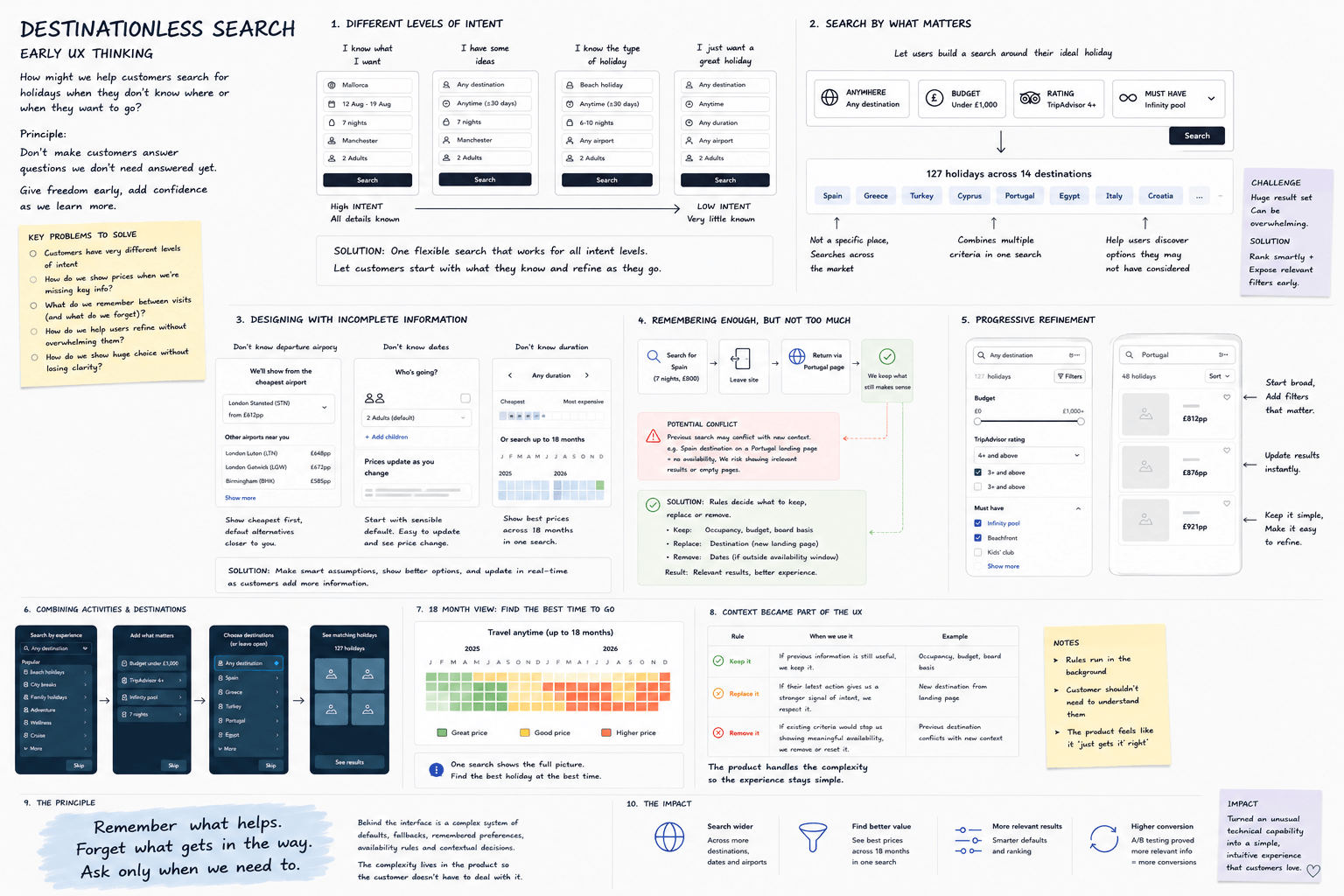
EARLY THINKING
What if users didn’t have to tell us anything?
We explored ideas that challenged what a holiday search form even needed to be.
The goal was simple: let customers search with all search criteria or nothing and discover from there.
THE COMPLEXITY BEHIND THE IDEA
Making everything optional created a new set of problems
If customers could search without telling us where, when or how they wanted to travel, the product had to make decisions on their behalf.
What inventory do we return?
What period do we price?
Where do we assume you’re flying from?
What price can we confidently show?
How broad should the search be?
The design challenge
The UX challenge
Freedom created complexity throughout the product. We needed to decide what price to show when dates weren't known. What airport to use when none had been selected. What occupancy to assume. Which preferences to remember. And when previously saved criteria should be removed because they conflicted with a customer's new intent. The goal was to make those decisions feel invisible.
Give customers as much flexibility as possible, while progressively making the results more personal and accurate as we learn what matters to them.
THE APPROACH
How do you build one search experience for someone who knows exactly what they want and someone who barely knows where they want to go?
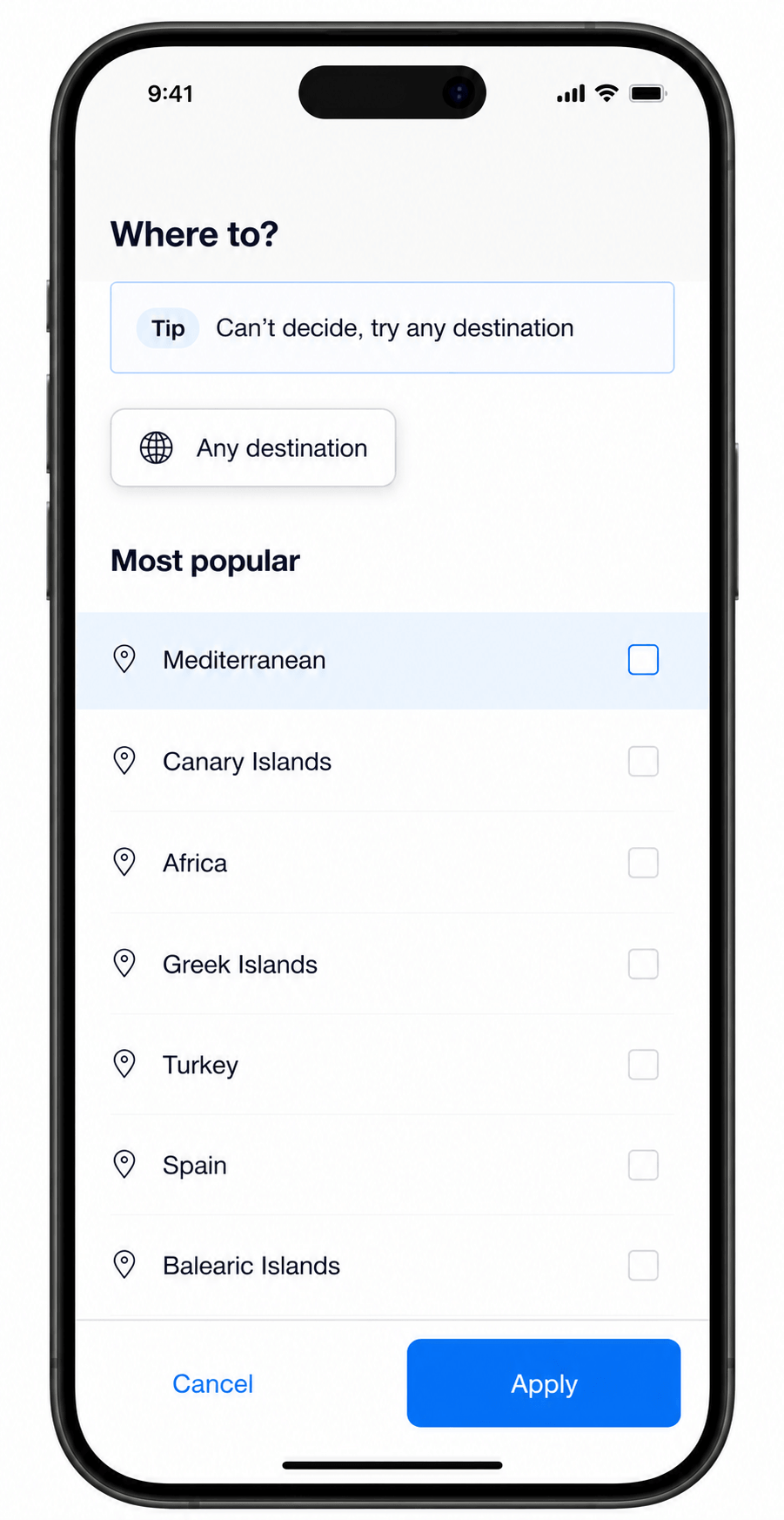
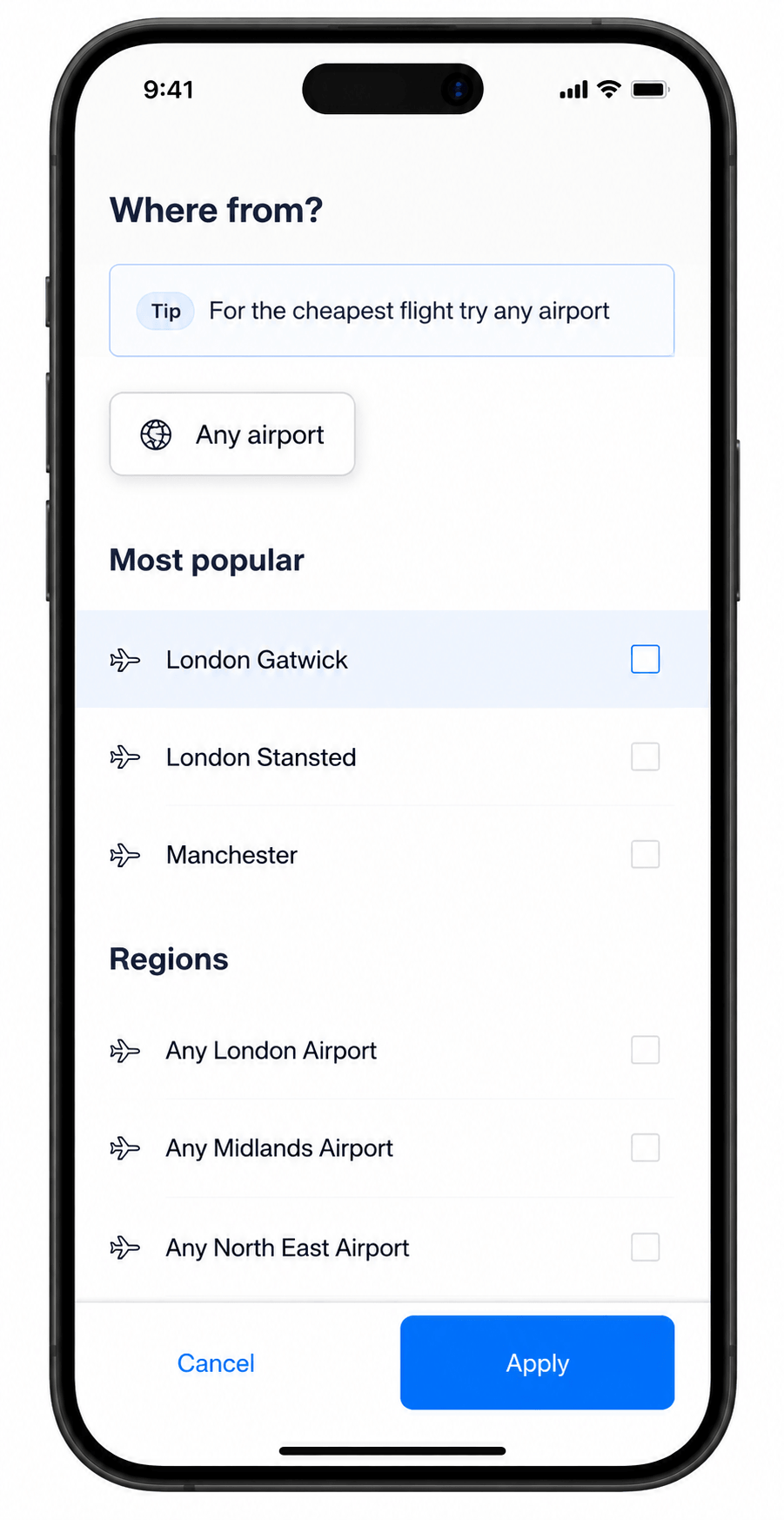
Rather than asking customers to complete a search form before they could see holidays, we made the criteria optional. Destination could default to Any destination, Any airport, Any date, dates could remain open. Customers didn’t need to choose a departure airport. And sensible defaults could be used for duration and occupancy based off data for what we know customers are booking. In our case two adults was the biggest user.
A customer who knew exactly what they wanted could still enter every detail and run a precise search. But someone who knew nothing yet could simply press Search and start exploring.
From there, users could progressively narrow thousands of possible holidays by destination, price, dates, airport, duration and other preferences.
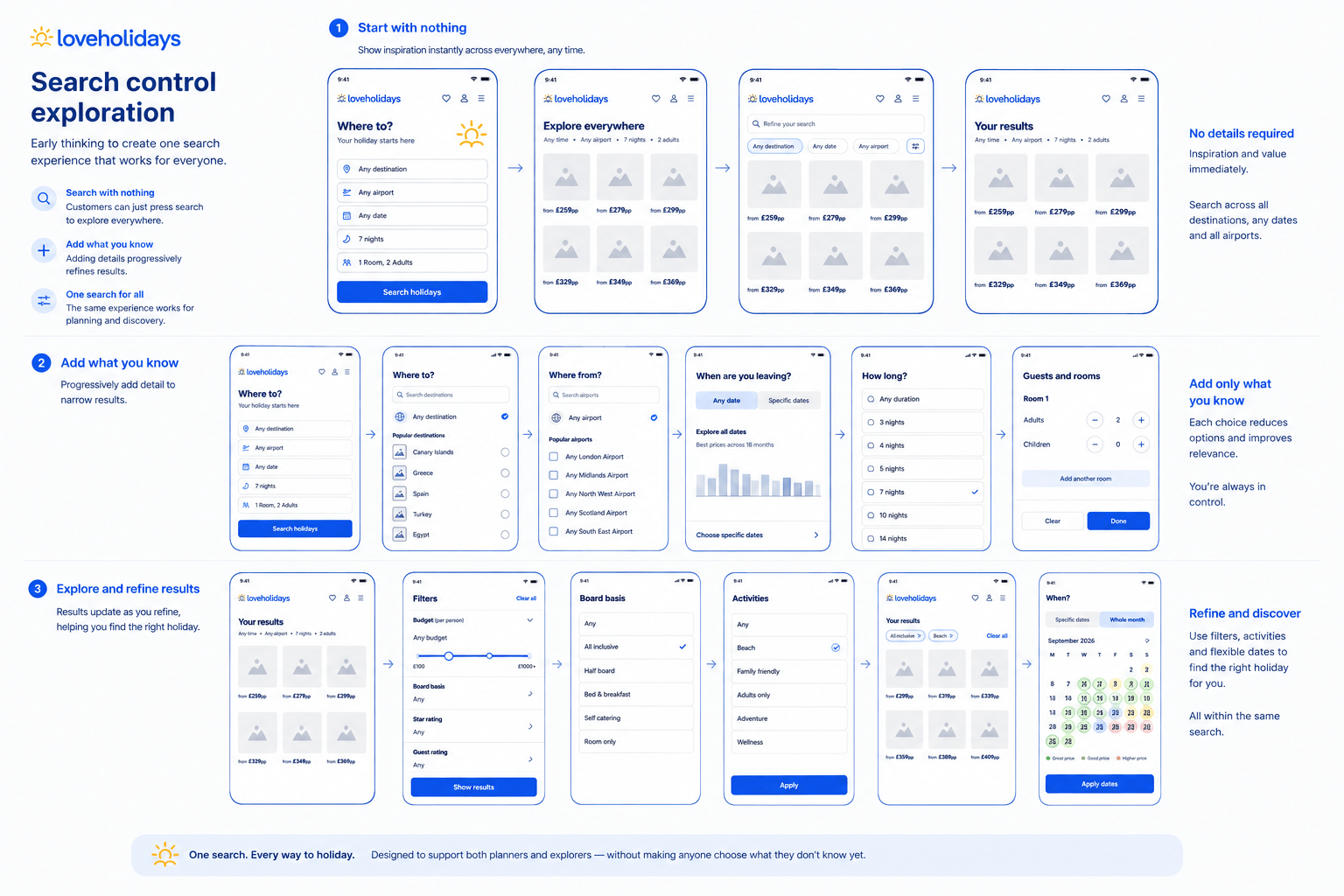
One search could therefore support two very different behaviours: finding a holiday you already had in mind, or discovering one you didn’t know existed.
DESIGNING AROUND UNKNOWNS
What price do you show when you don’t know everything?
Open search (the term we coined this feature) meant we often had to show results before knowing every detail required to calculate the customer’s eventual holiday. So we designed sensible defaults and progressively improved the results as we learned more.
Don’t know your departure airport?
We initially surfaced the cheapest available flight rather than forcing customers to choose an airport before exploring.
This revealed that some customers were happy to travel further for a better price.
Closer to booking, we showed alternative flights from airports nearer their location so they could balance price and convenience.
Don’t know your occupancy?
Occupancy changes both availability and price. We started with a sensible assumption made from data, using our most popular cohort (2 adults) and made it easy for customers to add their actual party and immediately see how their options changed.
Don’t know your dates?
We searched across the wider availability window of 18 months and returned the cheapest price, which in turn surfaced value before asking customers to narrow their dates. The UI progressively became more accurate as customer intent became clearer.
Making smart assumptions in detail
We don't know your departure airport
Rather than blocking the search, we could initially show the cheapest available option in an 18 month range from the current date. This sometimes surfaced significantly better prices from airports customers hadn't considered and some were willing to travel further for the saving.
As customers moved closer to booking, we introduced alternative flights from airports nearer their location. This made the trade off between price and convenience clear before they committed.
So the UX challenge wasn't simply collecting more data or asking for less.
It was deciding what we needed to know, when we needed to know it, what we could safely assume, and when an old assumption should be discarded.
Search didn’t end when you left
We learned through A/B testing that retaining useful search information increased the likelihood of conversion. So we remembered customer criteria between visits so they could continue where they left off. But remembering everything created another problem.
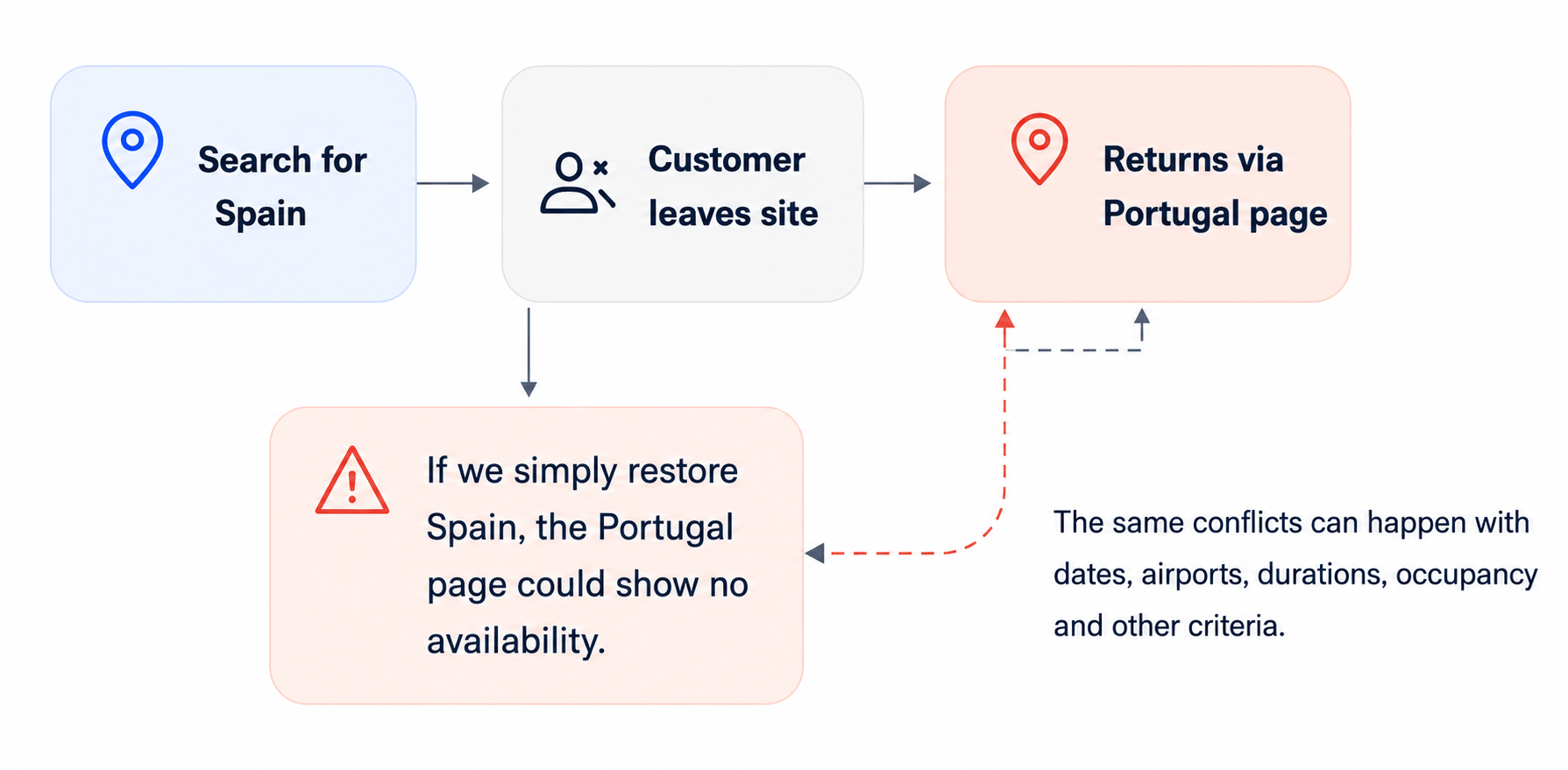
A customer might search for Spain, leave the site, then return through a Portugal landing page. If we simply restored Spain, the Portugal page could show no availability.
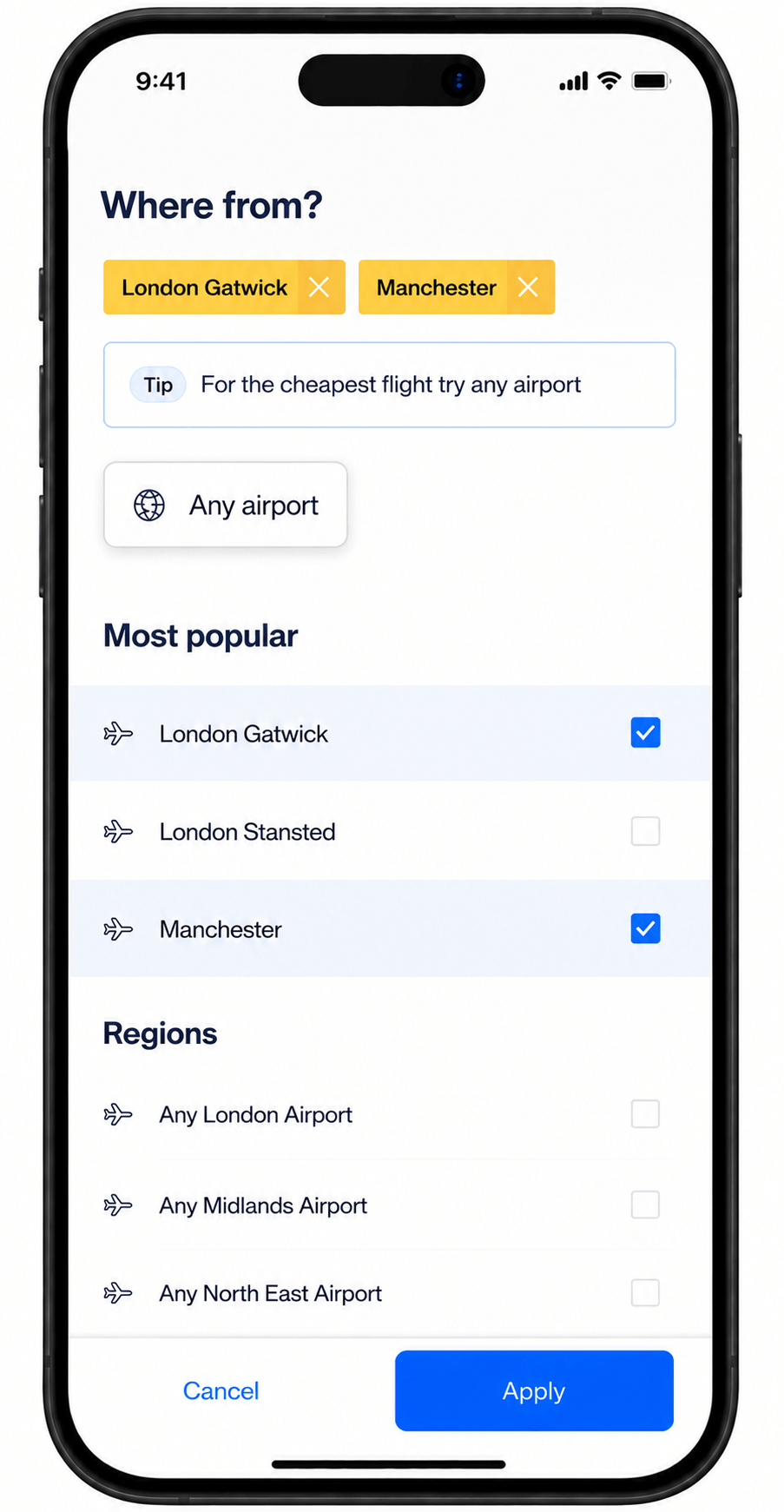
The same conflicts could happen with dates, airports, durations, occupancy and other criteria, for example a user adds a Manchester airport but they return on a destination page that there are no flight paths to from Manchester, what would they see on that landing page?
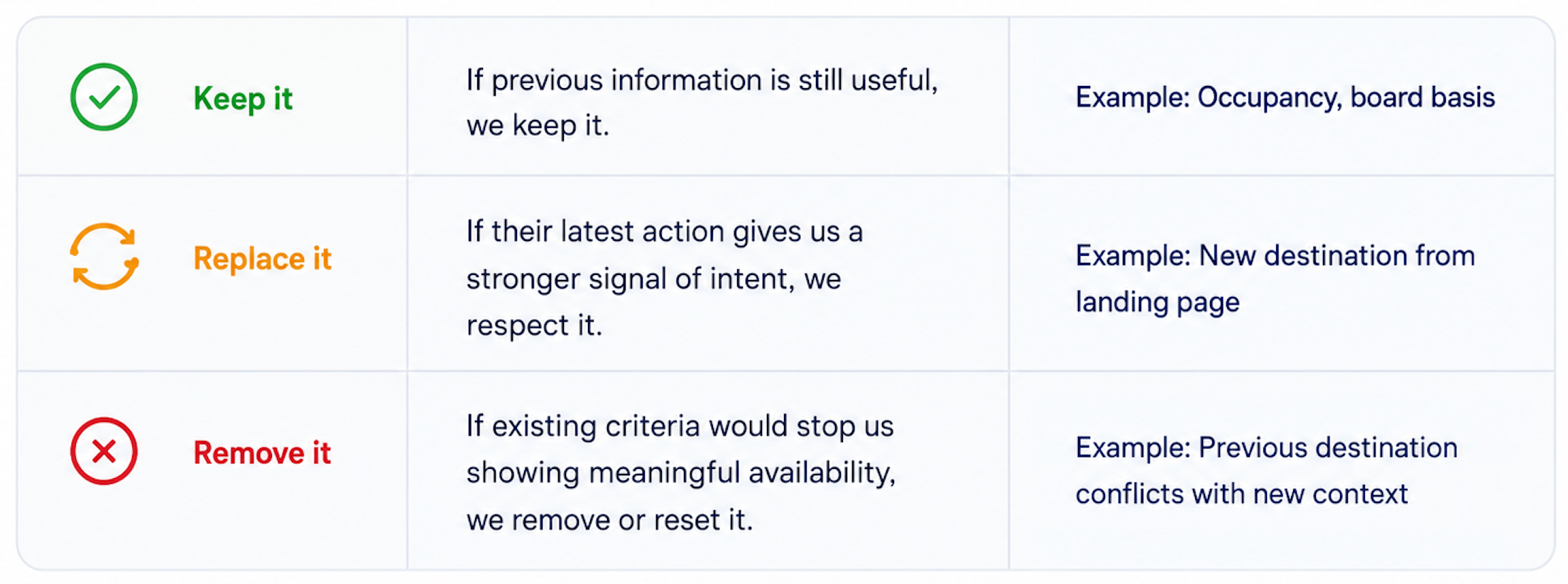
A search needs to understand how you arrived
We developed rules around what should be retained, replaced or removed depending on the customer’s context. Users weren’t aware of this background rules, and nor did they need to be, instead they enjoyed what was seeming a very smart search that retained the most important criteria users had, saving repeatedly entering it, speeding up their product browsing time and highlight the best value at all times.
THE BIG DIFFERENTIATOR
What if you don't know when you want to go?
We made dates optional. Leave them open and we searched up to 18 months of availability to surface the best value. Then at a later stage down the funnel post hotel selection we could drive users to selecting a date. But what date should we show by default? so we can still give users a lead in price?
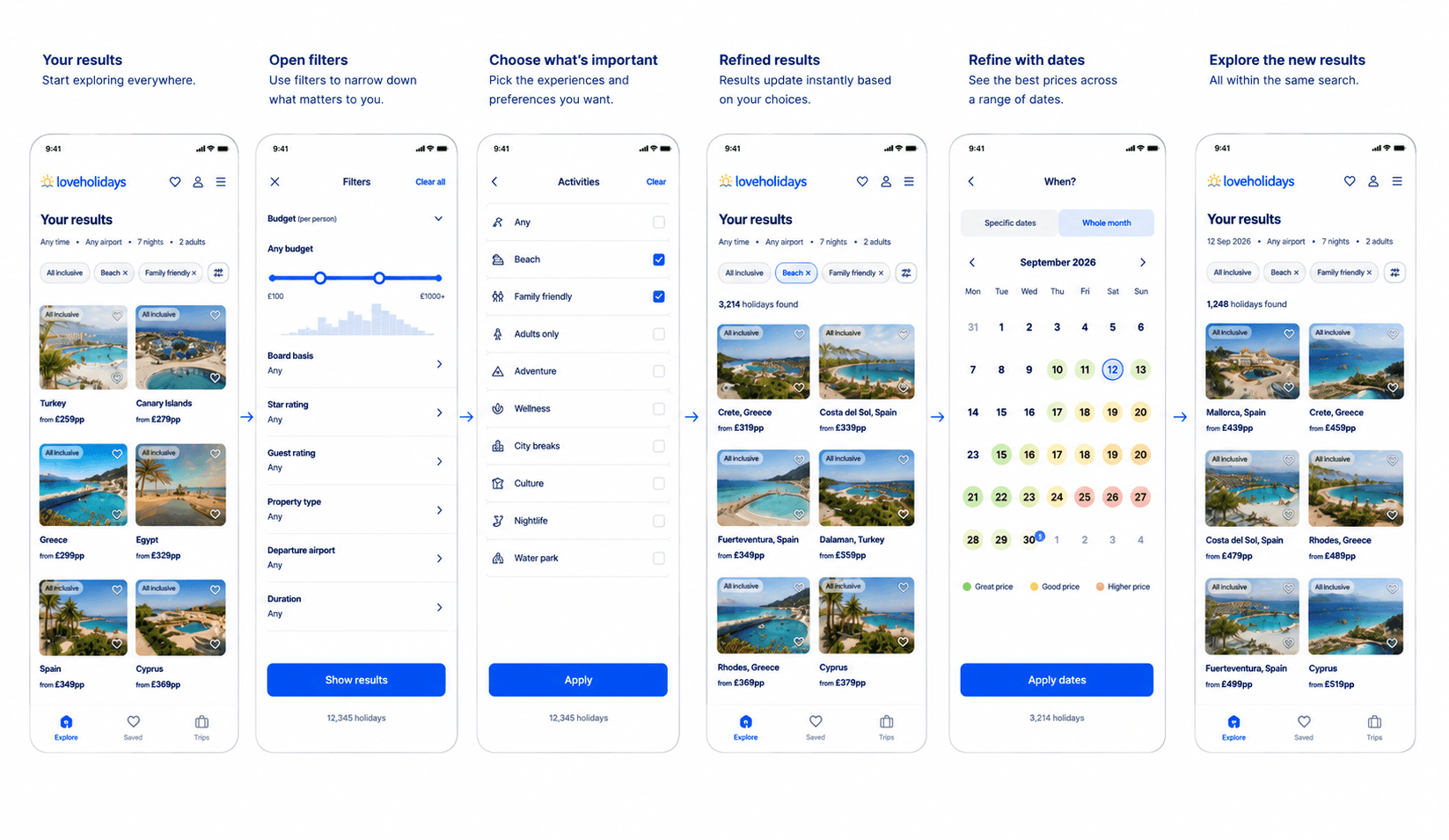
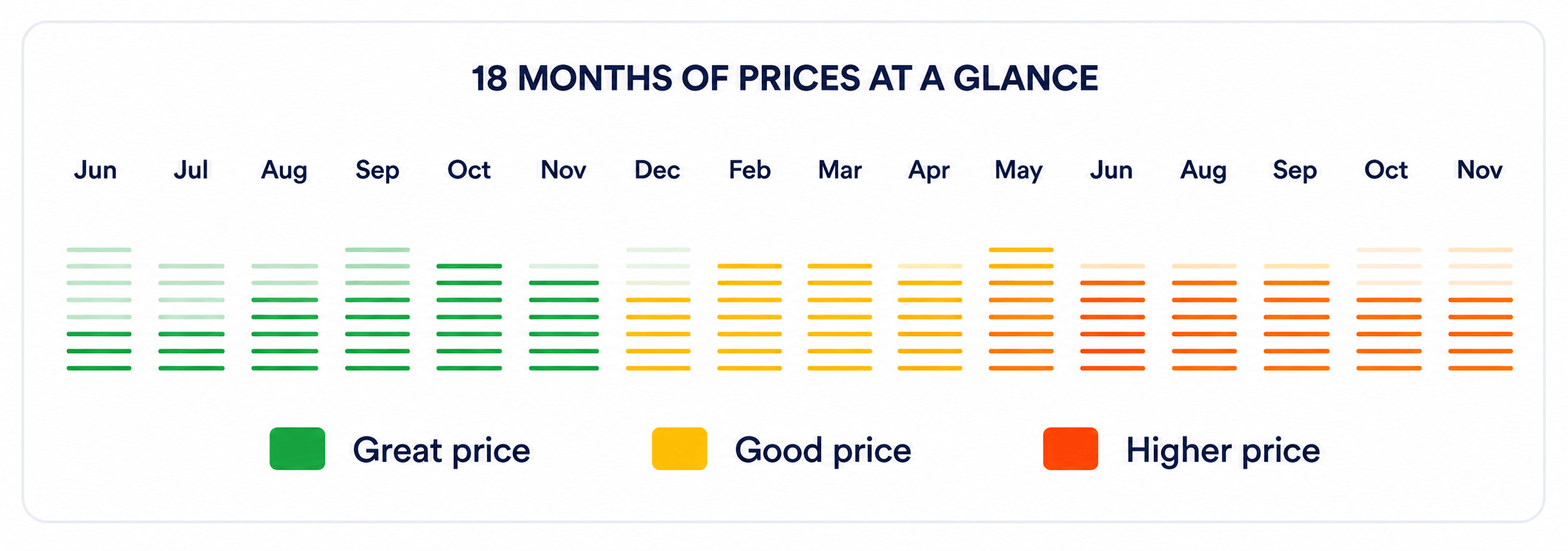
Customers could then filter those results until they found the right balance of destination, date, duration and price.
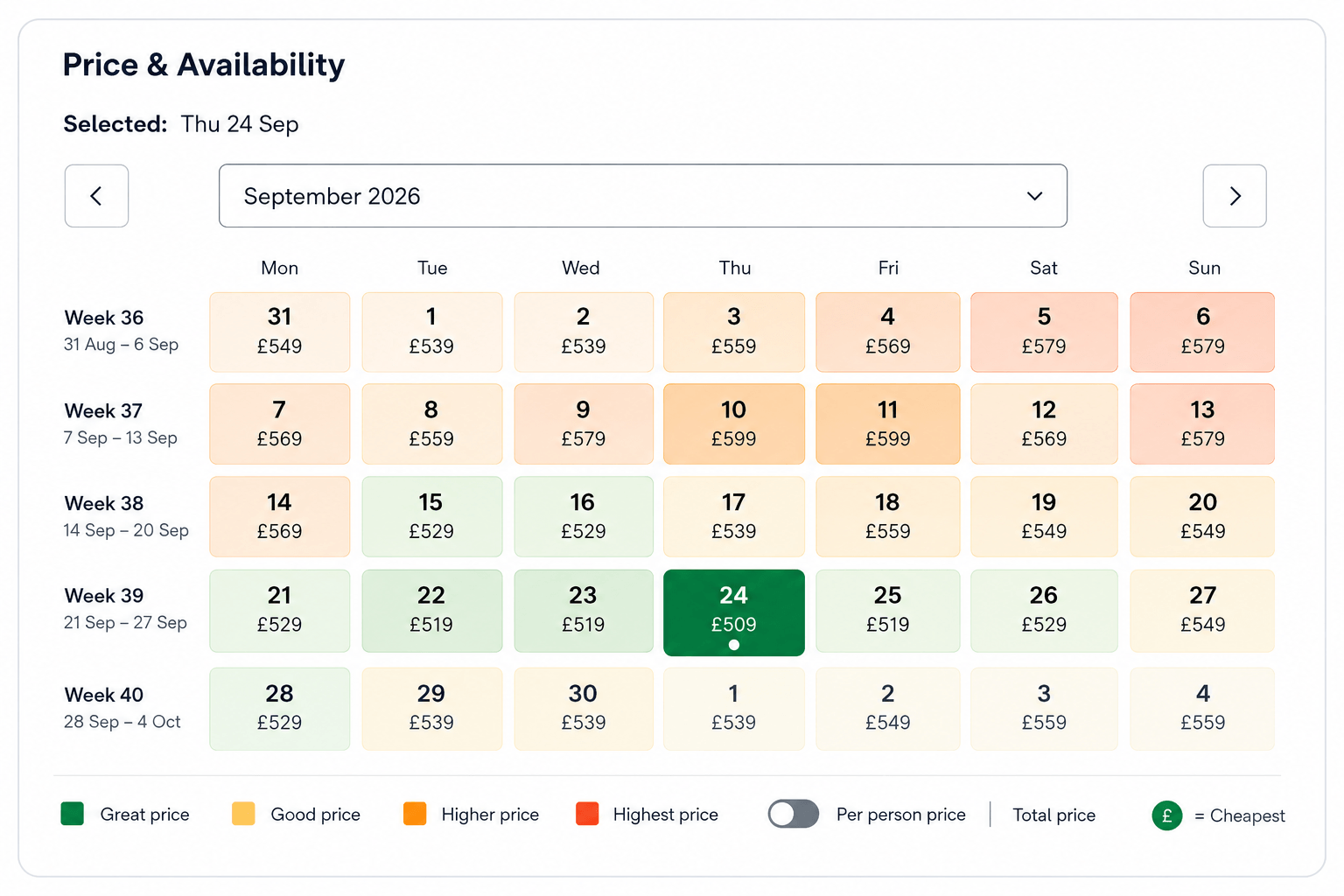
BRINGING THE THINKING TOGETHER
Progressive intent
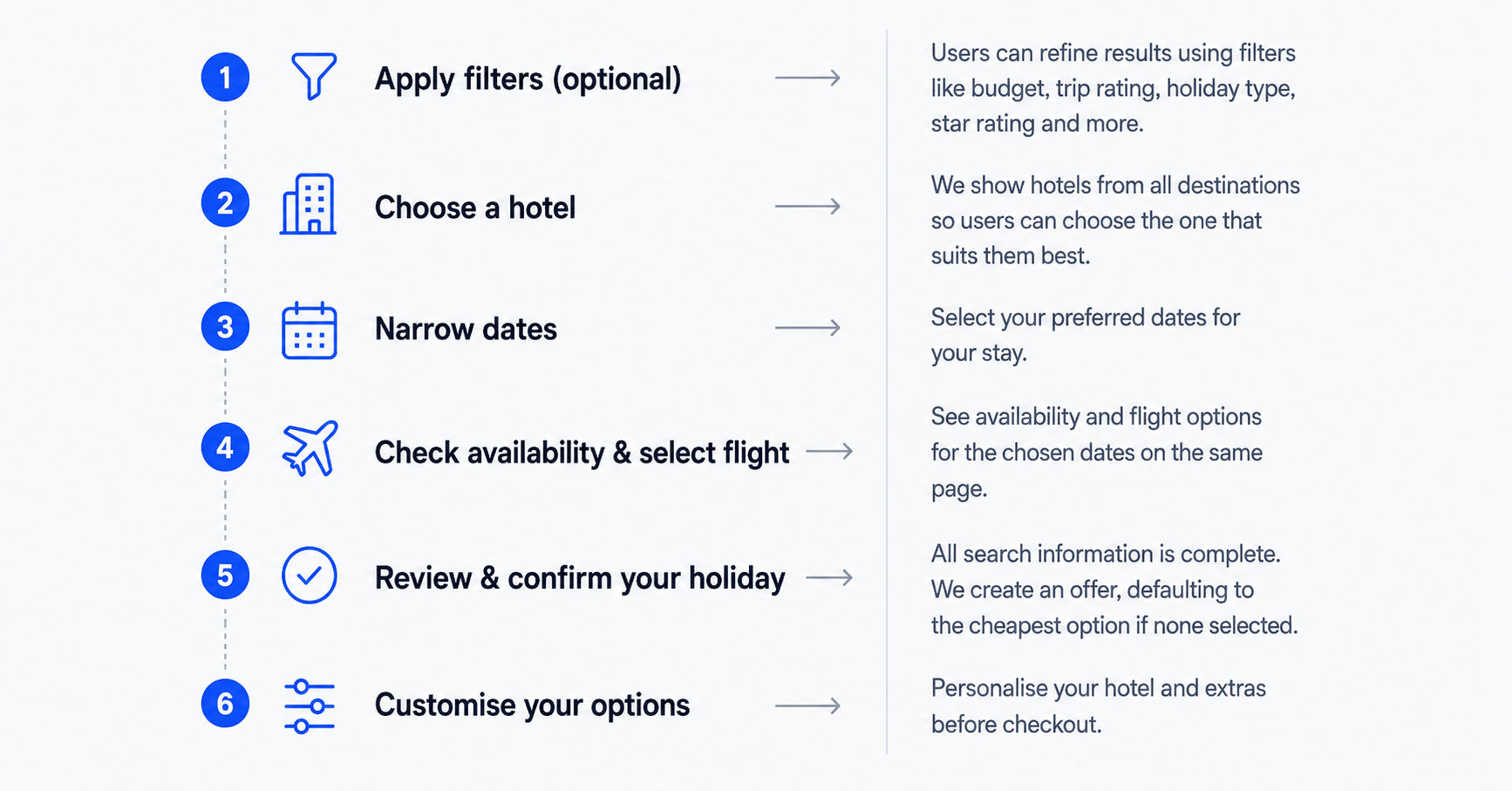
Customers reveal what they want over time. Customers could now see hotels from across all off our destinations and not be tied into hotels in a geographical location near their arrival airport.
The results? User could now search in the most extraordinary way, they could for example ask to be shown all trip advisor rated hotels 4 and above, with infinity pools, all inclusive, regardless of destination, performing a worldwide search and seeing where their budget could take them.
Initial feedback from users was every strong, with users being able to find holidays they thought were out of reach for their budget, we also highlighted the cheapest times to visit these locations meaning user where able to find incredible value or money.
Search for the holiday, not the destination
Most travel sites ask “Where do you want to go?”. We let customers start with what they care about.
Our technology searches across multiple destinations, dates, durations and airports in one go.
Anywhere
Any destination
Budget
Under £1,000
Rating
TripAdvisor 4+
Must have
Infinity pool
The benefit to users
Flexibility that delivers results
This wasn’t flexibility for its own sake, it allowed loveholidays to expose combinations and prices that were difficult to discover elsewhere.
Customers could:
- Search without knowing where to go
- Explore up to 18 months at once
- Search across multiple destinations
- Compare more holiday combinations
- Discover destinations they hadn't considered
- Find the best dates for their budget
- Compare departure airports
- Trade convenience for a better price
- Refine without starting again
- Pick up where they left off
- Find the very best value
- Go from discovery to a precise search
Turning an unusual technical capability into a simple, intuitive experience helped loveholidays grow into one of the UK’s leading online travel businesses.
THE IMPACT
From startup idea to a multi billion pound travel business
Destination less search wasn't a feature sitting at the edge of loveholidays. It was at the heart of the product proposition and a major reason customers could find value in a way other travel sites couldn't offer.
I played a major role in shaping that experience as the company scaled, designing how customers searched, discovered, refined and returned to holidays across millions of possible combinations.
The principles we established around flexibility, progressive intent, intelligent defaults and experimentation became part of the foundation the product continued to build on.
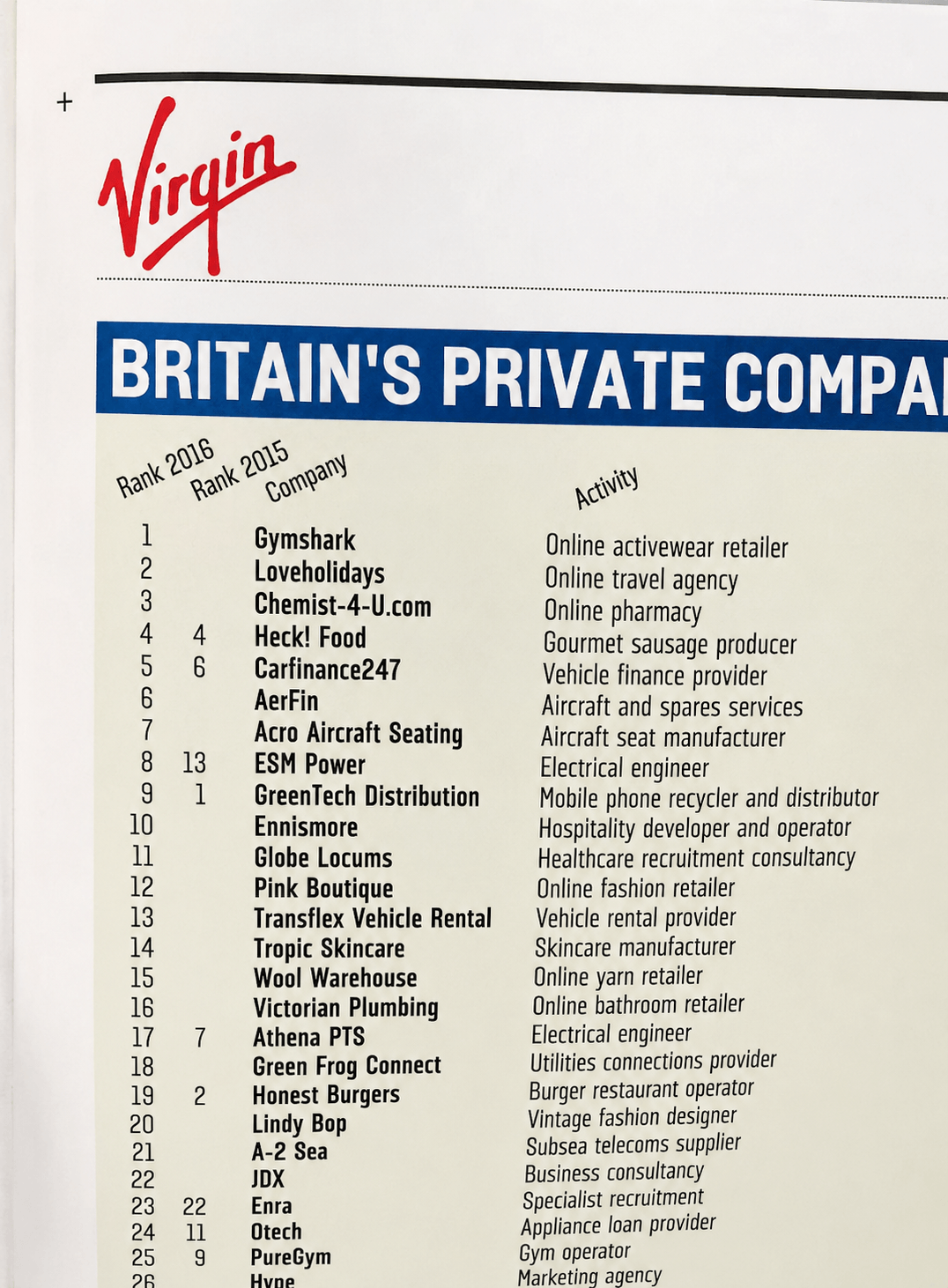
- 2nd fastest growing company in the UK
- Most profitable privately owned company in the UK
- Sunday times virgin fast track 100
- Top 4 ATOL holder


The search philosophy scaled with the business
What began as a different way to search became a defining part of the loveholidays experience.
Today, customers can search across 47,000+ hotels and flights from more than 140 airlines, while the same fundamental idea remains: give people the flexibility to search broadly, discover more options and find the best possible value.